New Anti-Corruption Measures Aim to Protect the Integrity of the Tournament
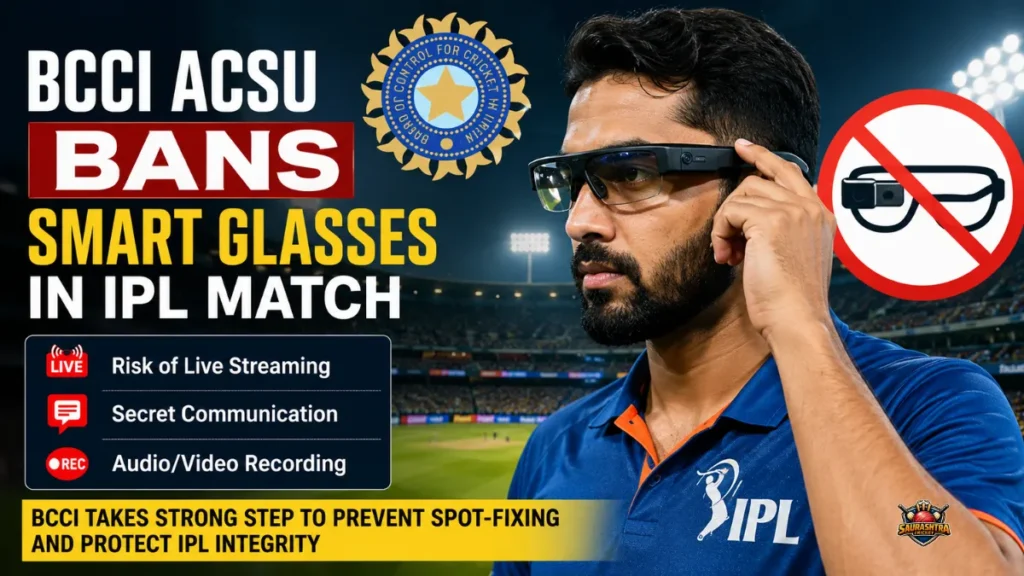
BCCI ACSU Bans Smart Glasses In IPL Match: The Board of Control for Cricket in India (BCCI) has introduced another significant anti-corruption measure during the ongoing Indian Premier League (IPL) season. In a move designed to prevent unauthorized communication and reduce the risk of spot-fixing, the Anti-Corruption and Security Unit (ACSU) has instructed players, coaches, and support staff not to use smart glasses and other advanced wearable devices on match days.
The latest advisory reflects growing concerns about how rapidly evolving technology could be misused within professional sports. Devices that appear ordinary on the surface may now be capable of recording conversations, transmitting live video, sending messages, and making calls without attracting attention. According to officials responsible for maintaining the integrity of the league, such technology could potentially create vulnerabilities that corrupt elements might attempt to exploit.
The decision highlights the IPL’s continuing efforts to stay ahead of emerging threats and maintain one of the most comprehensive anti-corruption systems in world cricket.
Why the BCCI ACSU Bans Smart Glasses In IPL Match
The primary concern behind the decision is the ability of modern smart eyewear to function as communication and recording devices. Unlike traditional sunglasses, many smart glasses can connect to mobile networks or Wi-Fi connections, allowing users to stream video, exchange messages, record audio, and even conduct voice or video calls.
From an anti-corruption perspective, these capabilities present a challenge.
Cricket administrators have long worked to prevent unauthorized sharing of information from inside team environments. Details about team strategy, player fitness, dressing-room discussions, pitch conditions, and match tactics can have significant value for betting syndicates. The ACSU believes that wearable devices with hidden communication features could potentially be used to bypass existing security protocols.
As a result, officials have chosen to take a preventive approach rather than waiting for a security breach to occur.
Concerns Over Secret Communication and Live Streaming
One of the biggest worries for anti-corruption authorities is the possibility of covert communication during matches.
Modern wearable technology has become increasingly sophisticated. Some smart glasses are capable of capturing high-quality video, transmitting live footage, and receiving real-time messages without requiring visible interaction from the user. Such features make it difficult for security personnel to detect whether a device is being used simply as eyewear or as a communication tool.
The ACSU fears that these capabilities could potentially be exploited to relay information from restricted areas or facilitate contact with unauthorized individuals.
Officials are particularly focused on preventing any activity that could compromise the fairness of matches or create opportunities for spot-fixing and betting-related manipulation.
Strict Rules Inside the Player and Match Officials Area
The restrictions are especially relevant within the Player and Match Officials Area (PMOA), one of the most tightly controlled sections of an IPL venue.
Under existing IPL regulations, devices capable of recording audio or video, as well as those that allow communication with external parties, face strict restrictions inside these designated areas. The ACSU has now clarified that smart glasses and similar wearable technologies fall under these categories.
Players and support staff have been instructed not to carry such devices into restricted zones on match days. Before entering sensitive areas, individuals must deposit mobile phones, smartwatches, and any other prohibited communication devices with designated security officials.
Failure to follow these protocols could result in disciplinary action under IPL operational regulations.
Growing Popularity of Smart Wearables Raises New Challenges
The ACSU’s latest warning comes amid the rising popularity of wearable technology across the world.
Technology companies have aggressively promoted smart eyewear products that combine fashion with advanced digital capabilities. Many of these devices can perform tasks that previously required smartphones or computers.
According to sources familiar with the matter, cricket administrators became concerned after learning that several companies were actively marketing smart eyewear products to individuals associated with IPL franchises.
While these products have legitimate everyday uses, anti-corruption officials believe their increasing sophistication requires additional safeguards within professional sports environments.
The issue demonstrates how sports governing bodies must continually adapt to technological developments that can create unforeseen security risks.
IPL Intensifies Surveillance Measures During the Season
The advisory regarding wearable technology is not an isolated action. It forms part of a broader effort by the ACSU to strengthen monitoring and security procedures throughout the IPL season.
Over the years, the anti-corruption unit has expanded its surveillance network significantly. Monitoring now extends beyond the playing field to include team hotels, practice facilities, dressing rooms, hospitality areas, and team transportation arrangements.
Officials continuously assess new risks and update security procedures when necessary. The latest directive regarding smart glasses reflects this proactive approach.
Cricket authorities believe that maintaining the integrity of the tournament requires constant vigilance, especially as technology and betting markets continue to evolve.
Previous Concerns About Unauthorized Access
The ACSU has also recently expressed concerns regarding unauthorized individuals gaining access to areas close to players and team personnel.
Earlier in the season, officials reportedly raised questions about people spending time around team dugouts and hospitality zones without a clear operational requirement. Such areas are considered sensitive because they provide opportunities for informal interaction with players and support staff.
Following these concerns, IPL franchises were reminded of access-control protocols and instructed to ensure that only authorized personnel could enter designated areas.
League officials emphasized the importance of maintaining strict boundaries between players and outside individuals throughout the tournament.
Temporary Staff Also Covered Under Security Protocols
The ACSU’s oversight extends beyond players and coaches.
Temporary staff members, including net bowlers, throwdown specialists, logistics personnel, and support workers, are also expected to comply with security guidelines. Teams have been advised to ensure that all personnel understand and follow anti-corruption regulations.
Officials believe that maintaining strong security standards requires participation from everyone involved in the tournament, not just high-profile players.
By enforcing consistent rules across all levels of team operations, the IPL aims to reduce vulnerabilities and create a safer environment for competition.
Additional Focus on Public Interactions
Another important aspect of the ACSU’s work involves monitoring situations where players may come into contact with unknown individuals.
Historically, anti-corruption investigators have viewed locations such as hotel lobbies, cafés, smoking zones, and hospitality venues as potential points of risk. These settings can provide opportunities for bookmakers or unauthorized agents to approach players and team staff.
For this reason, teams are regularly advised to limit unnecessary movement in public areas and remain alert to unusual interactions.
Officials have also warned players against accepting gifts, participating in undisclosed business arrangements, or engaging with unfamiliar individuals through social media and private events.
These guidelines are intended to reduce opportunities for inappropriate influence or information gathering.
Lessons Learned From the 2013 Spot-Fixing Scandal
Many of the IPL’s current anti-corruption measures trace their origins to the spot-fixing controversy that shook the tournament in 2013.
The scandal exposed weaknesses in the league’s security systems and prompted a comprehensive review of anti-corruption procedures. Since then, the BCCI has invested heavily in strengthening oversight mechanisms and expanding the powers of the ACSU.
The result has been a far more robust framework designed to identify suspicious activity, monitor interactions, and educate participants about corruption risks.
Over the past decade, the IPL has continually refined these systems to address new challenges, including those posed by advances in technology.
The Future of Integrity Protection in Cricket
The decision surrounding smart glasses illustrates how anti-corruption efforts in professional sports must evolve alongside technological innovation.
As wearable devices become more powerful and discreet, sports organizations face increasing pressure to ensure that new technologies do not create opportunities for unfair advantages or illicit communication.
The BCCI ACSU Bans Smart Glasses In IPL Match directive represents a precautionary step aimed at protecting the credibility of one of the world’s most valuable cricket tournaments. By restricting devices capable of hidden communication and recording, officials hope to close potential loopholes before they can be exploited.
For the IPL, maintaining trust among players, teams, sponsors, and fans remains a top priority. The latest measures demonstrate that cricket authorities are prepared to adapt quickly as new risks emerge, ensuring that the competition continues to be decided by performances on the field rather than influences behind the scenes.