
The MA Chidambaram Stadium Pitch Report remains a key point of interest whenever cricket arrives in Chennai. Known globally as Chepauk, this historic ground has built a reputation for producing matches that are rich in strategy, skill, and patience rather than sheer power. From legendary Test encounters to high-pressure T20 clashes, the pitch at this venue often dictates how a match unfolds.
Situated in Tamil Nadu’s capital city, the MA Chidambaram Stadium is one of the oldest active cricket grounds in the world. Its surface, atmosphere, and conditions are vastly different from modern flat tracks, making it crucial for teams and players to understand the pitch behavior before stepping onto the field.
This detailed report offers a fresh and complete look at the MA Chidambaram Stadium pitch report, covering pitch characteristics, batting and bowling trends, format-wise performance, historical relevance, weather influence, toss impact, and tactical planning.
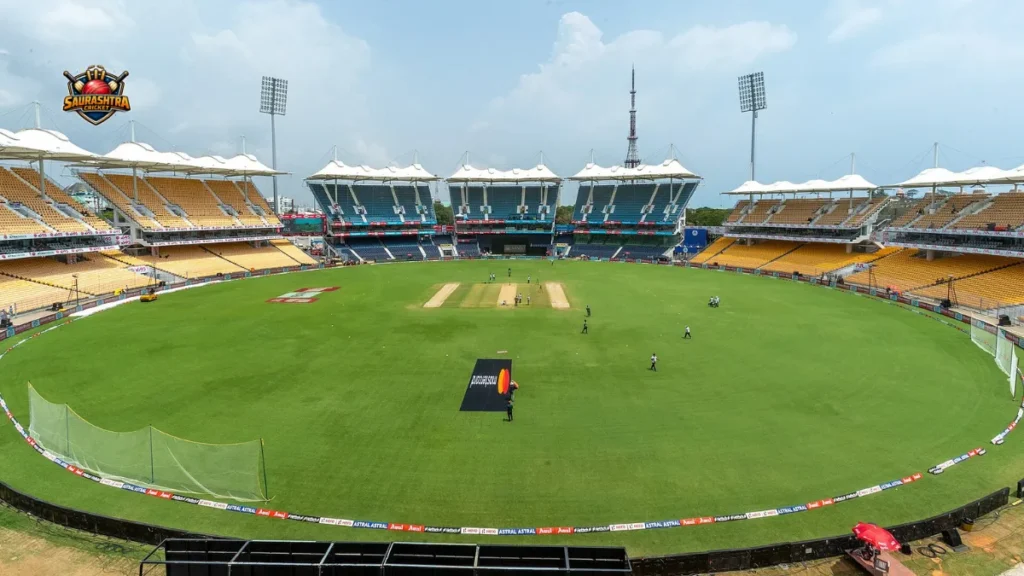
MA Chidambaram Stadium at a Glance
Before analyzing pitch conditions, it is important to understand the basic profile of the stadium itself.
MA Chidambaram Stadium Details Table
| Feature | Information |
|---|---|
| Official Name | MA Chidambaram Stadium |
| Popular Name | Chepauk |
| Alternate Name | Madras Cricket Club Ground |
| City | Chennai, India |
| Capacity | Around 38,000 spectators |
| Home Side | Tamil Nadu Cricket Team |
| Pitch Type | Natural grass (red soil base) |
| Floodlights | Introduced during the 1996 World Cup |
| Ends | Anna Pavilion End, V. Pattabhiraman Gate End |
Chepauk has continuously evolved while maintaining its traditional cricketing character.
Legacy and Cricketing Heritage of Chepauk
The MA Chidambaram Stadium holds a special place in cricket history. Competitive cricket has been played here since 1916, long before India became a dominant force in world cricket.
The ground hosted its first Test match during the 1933–34 season when England toured India under Douglas Jardine. Since then, Chepauk has been a stage for some of cricket’s most iconic moments.
Major historical highlights include:
- India’s maiden Test victory in 1951–52 against England
- The first-ever Ranji Trophy match played at this venue
- Sunil Gavaskar’s record-breaking 30th Test century
- The legendary tied Test between India and Australia in 1986–87
- Narendra Hirwani’s unforgettable Test debut with 16 wickets
Beyond statistics, Chepauk is celebrated for its deep respect for the spirit of the game.
Chepauk Crowd: Knowledgeable and Respectful
One of the most unique aspects of the MA Chidambaram Stadium is its audience. Cricket lovers in Chennai are known for appreciating quality cricket regardless of nationality.
This was famously demonstrated when Pakistan’s Saeed Anwar received applause for his record 194 against India in 1997. Again in 1999, the crowd showed rare sportsmanship by applauding Pakistan after their Test win, prompting the visiting team to acknowledge spectators with a lap of honour.
Such moments have enhanced Chepauk’s global reputation as a true cricketing venue.
MA Chidambaram Stadium Pitch Report: General Characteristics
The MA Chidambaram Stadium pitch report describes a surface that is traditionally slow and spinner-friendly. Unlike high-bounce or pace-heavy tracks, Chepauk challenges batters with low bounce, grip, and gradual turn.
The pitch is mostly prepared using red soil, which naturally wears down faster. As a result, conditions change significantly as matches progress, especially in longer formats.
Key pitch traits include:
- Limited pace off the surface
- Increasing turn for spinners
- Reduced bounce in later stages
- Difficulty in chasing targets
This makes match awareness and adaptability essential.
Batting Conditions at MA Chidambaram Stadium
MA Chidambaram Stadium Pitch Report for Batting
Batting at Chepauk requires technique and temperament. The MA Chidambaram Stadium pitch report suggests that batters must avoid reckless stroke play, especially against spin.
Early in the innings, the pitch offers reasonable batting conditions. Players who take time to settle can score runs through placement rather than power. However, as the ball gets older, timing becomes difficult.
Batting Phase Comparison
| Match Phase | Batting Conditions |
|---|---|
| Powerplay | Relatively comfortable |
| Middle Overs | Spin-dominated |
| Death Overs | Tough and unpredictable |
Batters who rotate strike effectively and play spin well usually succeed at this venue.
Fast Bowling Performance at Chepauk
Fast bowlers rarely dominate at MA Chidambaram Stadium through pace alone. According to the MA Chidambaram Stadium pitch report, seamers must depend on accuracy and variations.
Effective methods for pacers include:
- Slower deliveries
- Off-cutters and leg-cutters
- Bowling cross-seam
- Using dry pitch areas
Any early assistance with the new ball is short-lived, especially in day matches.
Spin Bowling Advantage at MA Chidambaram Stadium
Spin bowling is the defining feature of the MA Chidambaram Stadium pitch report. This ground has long been known as a paradise for spinners who understand flight, pace variation, and length control.
Finger spinners often enjoy consistent success, while leg-spinners can be lethal when the pitch starts breaking up. In Tests, spinners come into play as early as Day 2.
Even in limited-overs cricket, spinners dominate the middle overs and restrict scoring opportunities.
MA Chidambaram Stadium Pitch Report by Match Format
Test Cricket at Chepauk
Test matches at Chepauk heavily favor teams that bat first.
- Day 1: Best batting conditions
- Day 2: Surface slows down
- Day 3 onwards: Sharp turn and low bounce
Many Tests conclude within four days due to rapid pitch deterioration.
ODI Matches at Chepauk
ODI pitches are slightly more balanced but still support spin.
| ODI Factor | Observation |
|---|---|
| Preferred Strategy | Bat first |
| Ideal Total | 270–290 |
| Key Bowlers | Spinners |
Chasing teams often struggle under scoreboard pressure.
T20 Matches at Chepauk
T20 games at Chepauk reward smart cricket.
| T20 Aspect | Impact |
|---|---|
| Average First-Innings Score | 160–180 |
| Boundary Frequency | Limited |
| Match Winners | Spinners, variation pacers |
Big hitters must adapt their approach to succeed here.
Toss Importance at MA Chidambaram Stadium
The toss plays a vital role in match planning at Chepauk.
- Tests: Batting first is almost mandatory
- ODIs: Teams prefer setting a target
- T20s: Dew can influence decisions
Captains must factor in pitch dryness and match timing before deciding.
Average Scores at MA Chidambaram Stadium
Format-Wise Scoring Trends
| Format | Strong Score |
|---|---|
| Test | 350–400 |
| ODI | 270–290 |
| T20 | 160–180 |
These numbers highlight why defensive cricket often works well at Chepauk.
Weather Impact on Pitch Behavior
Chennai’s climate significantly affects the MA Chidambaram Stadium pitch report.
- High temperatures dry the pitch quickly
- Humidity increases grip for spinners
- Dew in night matches can assist chasing
Day games are especially demanding for both players and surfaces.
Winning Strategies at Chepauk
Teams that perform well at MA Chidambaram Stadium usually focus on:
- Strong spin combinations
- Batting first whenever possible
- Building partnerships
- Using bowling variations smartly
Teams that fail to adapt to conditions often struggle, regardless of reputation.
Conclusion: Why Chepauk Remains a True Test of Skill
The MA Chidambaram Stadium Pitch Report proves that Chepauk is not just another cricket ground—it is a venue that tests cricketing intelligence, patience, and adaptability.
Whether it is a classic Test match or a high-pressure T20 contest, the pitch here demands respect. Spin bowling, controlled batting, and strategic thinking remain central to success at this historic Chennai venue.
For fans, analysts, and fantasy cricket players, understanding the MA Chidambaram Stadium pitch report offers valuable insight into how matches are likely to unfold at one of cricket’s most iconic grounds.